Kiddex
One true record of your kid. Exactly the right slice for every caregiver.
Problem space
A child’s information is scattered across everyone who cares for them, and the parent holds it together by hand.
Solution to explore
One parent-controlled source of truth that can hand any caregiver, or any form, exactly the right slice and nothing more.
Project details
- A solo project: I framed it, designed it, and built the working app myself with AI tooling (Claude Code)
- Three names across three years: Pocketlore → Kiddex → Kiddoo. Same problem, reframed each time
- Status: a working alpha (now cold), one shipped AI feature, and a rebuild underway
Why I started building this
We found out my son had several allergies and allergic responses.
Suddenly a dozen adults needed to know exactly the right things about one small person: the sitter, the grandparents, the school office, the camp nurse, the coach doing pickup. I became the switchboard, retyping the same facts into every form, texting them to every new caregiver, stale the moment I hit send.
Nobody had the whole picture. I was the integration layer, and integration layers fail quietly.
If everyone caring for my kid needs a different slice of the same facts, why am I rebuilding those facts by hand every single time?
Treating sharing like distance
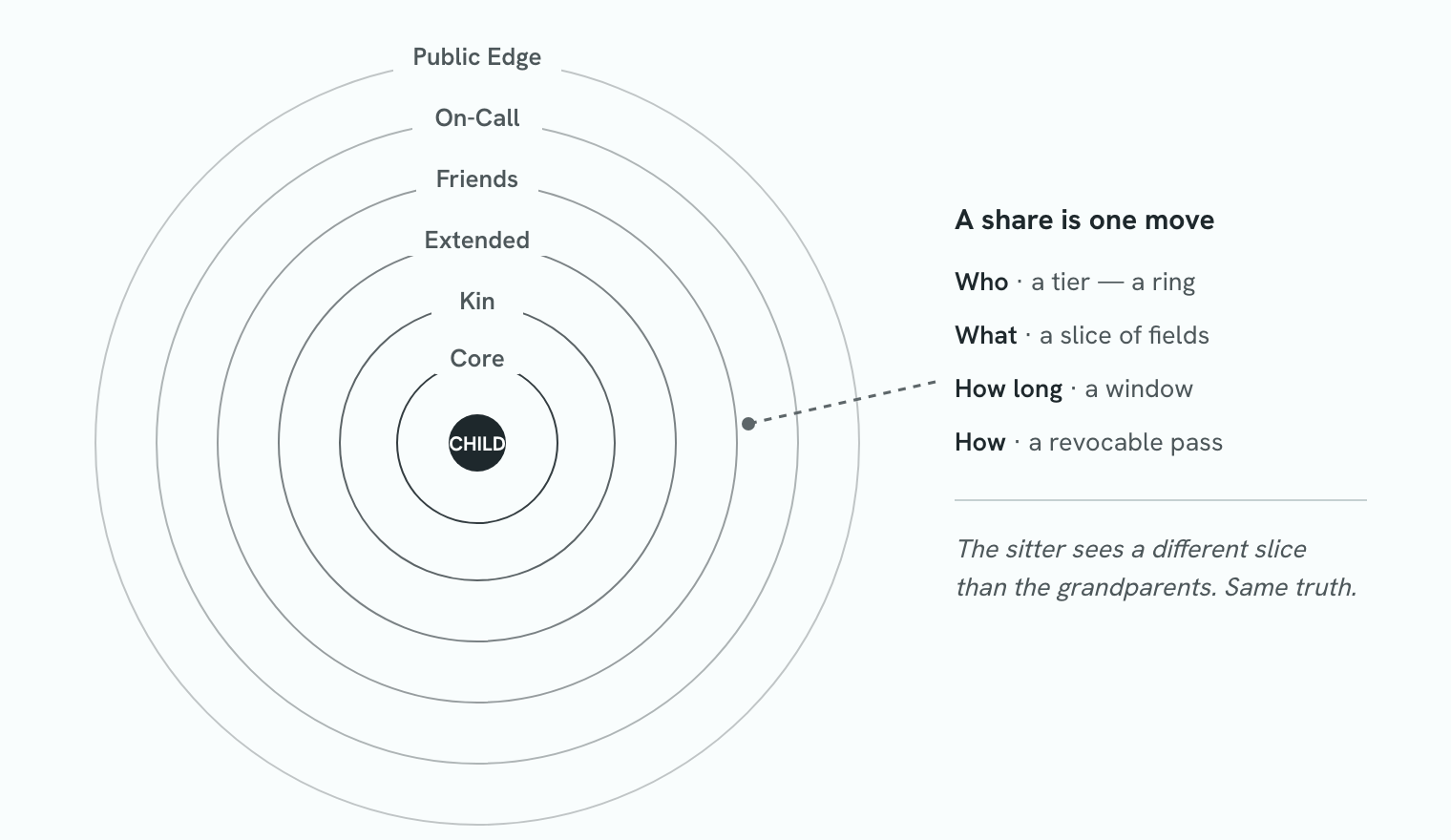
The first version was called Pocketlore. Its bet: permission isn’t a list, it’s a distance. A sitter for one night and a co-guardian for life aren’t two rows in a table. They’re two distances from the child.
Sharing broke into a small set of pieces:
- Who: a tier, by closeness. Core, Kin, Extended, Friends, On-Call, Public Edge.
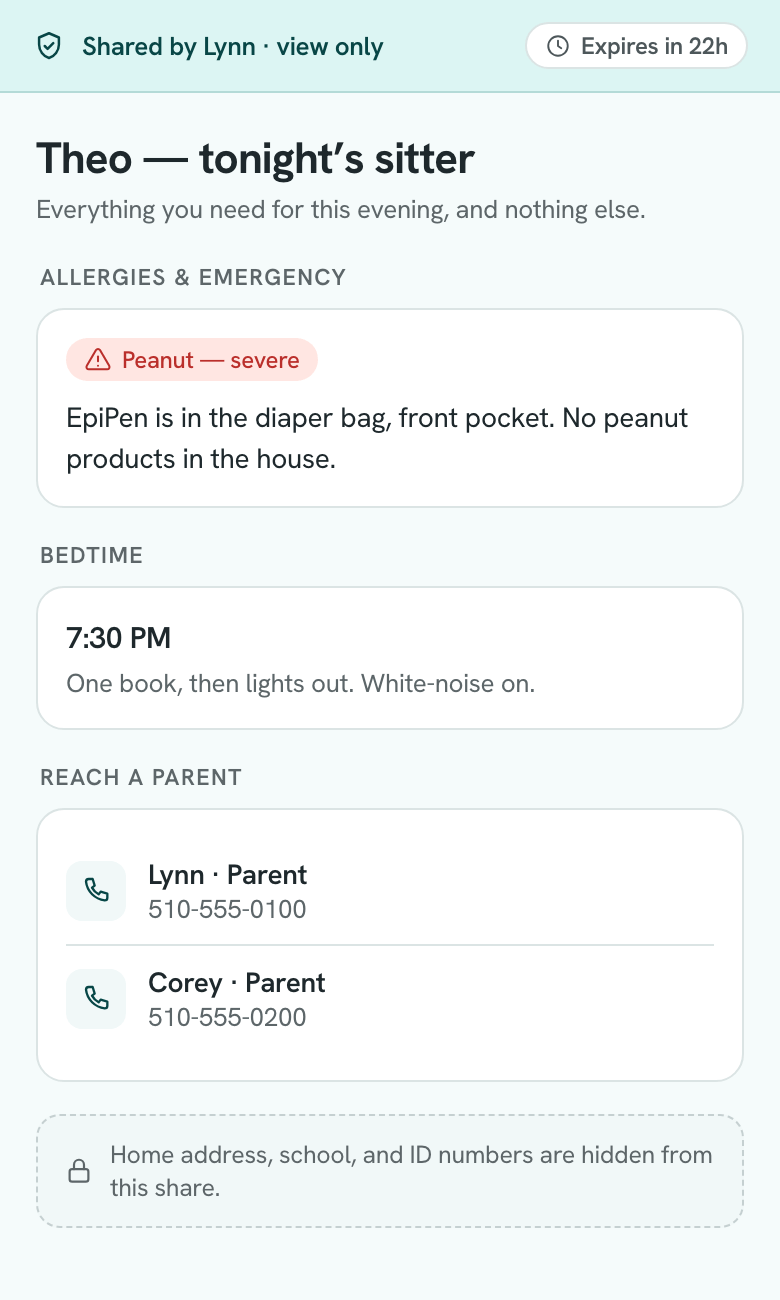
- What: a slice. A named bundle like Allergies & Emergency or Weekend Routine.
- How long: a window. 24 hours, a weekend, a season. A share is a loan, not a transfer.
- How: a pass. The link itself, revocable in one tap.
Every change is logged in plain language, so the most important sentence a parent ever writes — Allergy: none → peanut — is captured once, dated, and pushed to everyone currently allowed to see it.
The risk I designed against
The tiers were elegant, and elegance is expensive.
Would a stressed parent learn six tiers, or freeze at “which ring is the babysitter?” I leaned on presets and a recommended tier, so the structure runs underneath.
Building the real thing
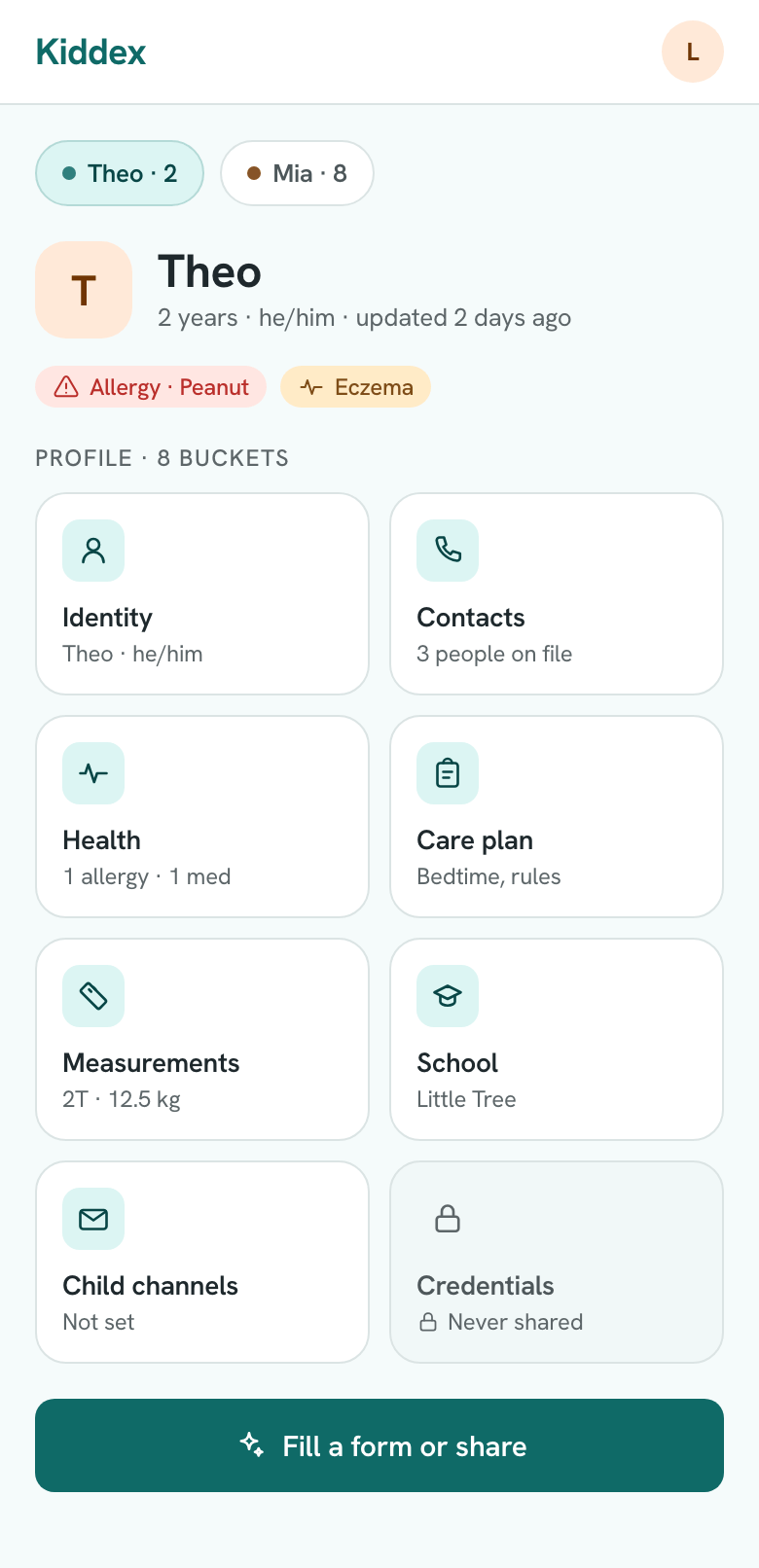
Then I built it: the actual app, not a prototype of one. The spine is a data model I think of as constitutional, eight structured buckets everything else plugs into.
- Identity, Contacts, Health, Care Plan, Measurements, School, and Child Channels, all parent-maintained and always current.
- Credentials (SSN, birth certificate) are never shared. Not “shared carefully.” Never.
One bucket says more than the other seven
The credentials wall is enforced in three separate places in the code, so no future feature can leak it by accident. The buckets are fixed: never add, remove, or merge.
The one bucket I refused to make shareable did more to define the product than the seven I did.
On that spine, the alpha runs multi-guardian access with per-bucket permissions, a suggest-and-approve flow so a co-parent proposes changes instead of overwriting them, time-boxed revocable shares, and a full audit log.
Making the data do the work
A perfect, current profile that just sits there still leaves the parent typing. So the next question:
What if you entered the thirty facts once, and the app filled every differently-shaped box after that?
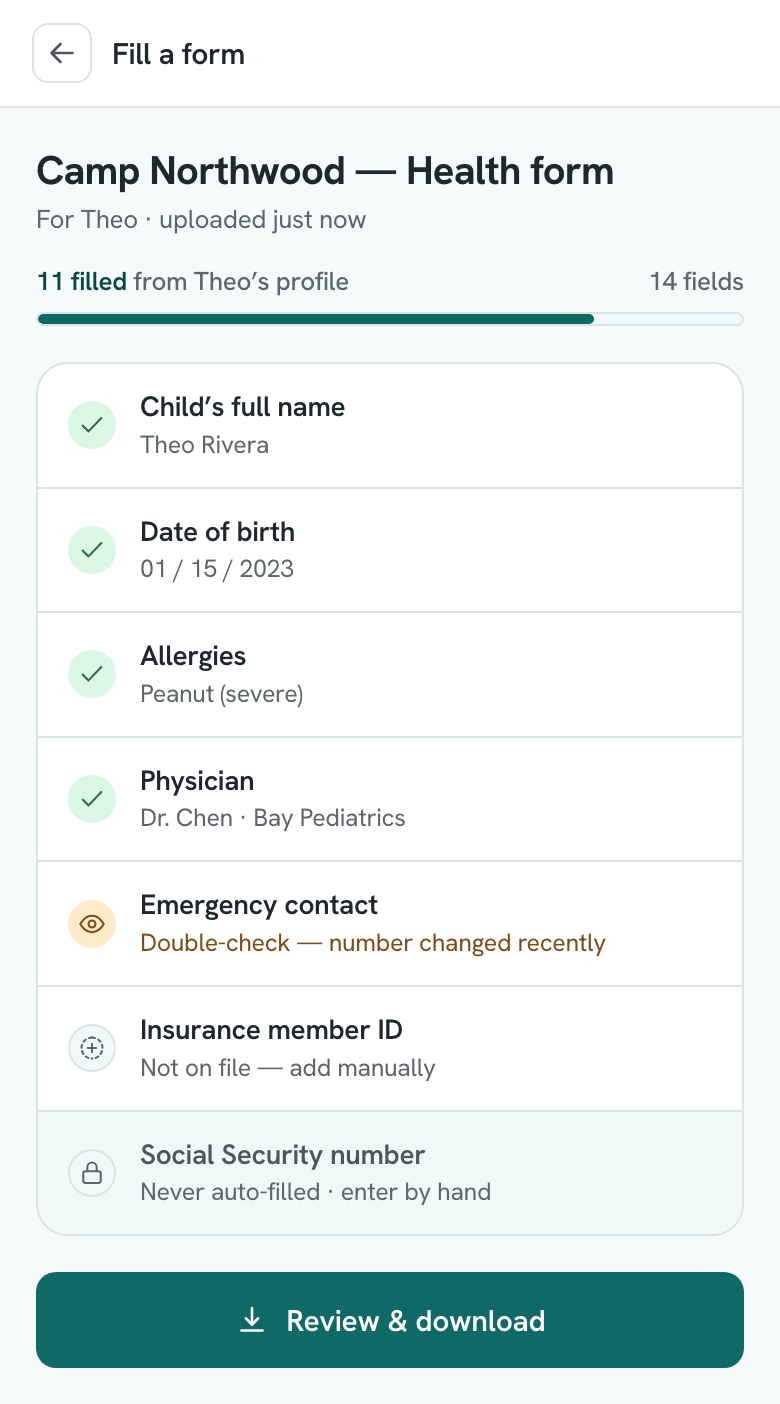
That became the form filler. Upload a PDF (a camp physical, an enrollment packet) and the AI maps each field to the child’s buckets, fills what it can, and flags the gaps for review before anything leaves. Credentials are stripped before the AI sees the data.
Testing my most ambitious idea
By spring I had a grander story: not “sharing plus a form filler” but a self-updating family dossier that knows each kid well enough to generate anything. Packing lists, briefings, prep checklists.
I wanted it to be true. That’s exactly when I don’t trust myself.
So I ran a bounded exploration with rules I had to follow: one focused session to make the case, a two-week deadline, archive by default if I never logged a decision. It had one test to pass.
Is the recurring pain really not knowing what your family needs each week, or is it just filling the forms already in front of you?
The concrete version kept winning. The grand framing was seductive and vague; the small one was specific and true. I killed the first to keep the second.
The reframe that made it simple
Killing the big idea left a gap, and the right one walked into it.
For two years I’d carried Kiddex as two products wearing one logo (a sharing vault and a form filler) and kept trying to decide which was the real one. Wrong question.
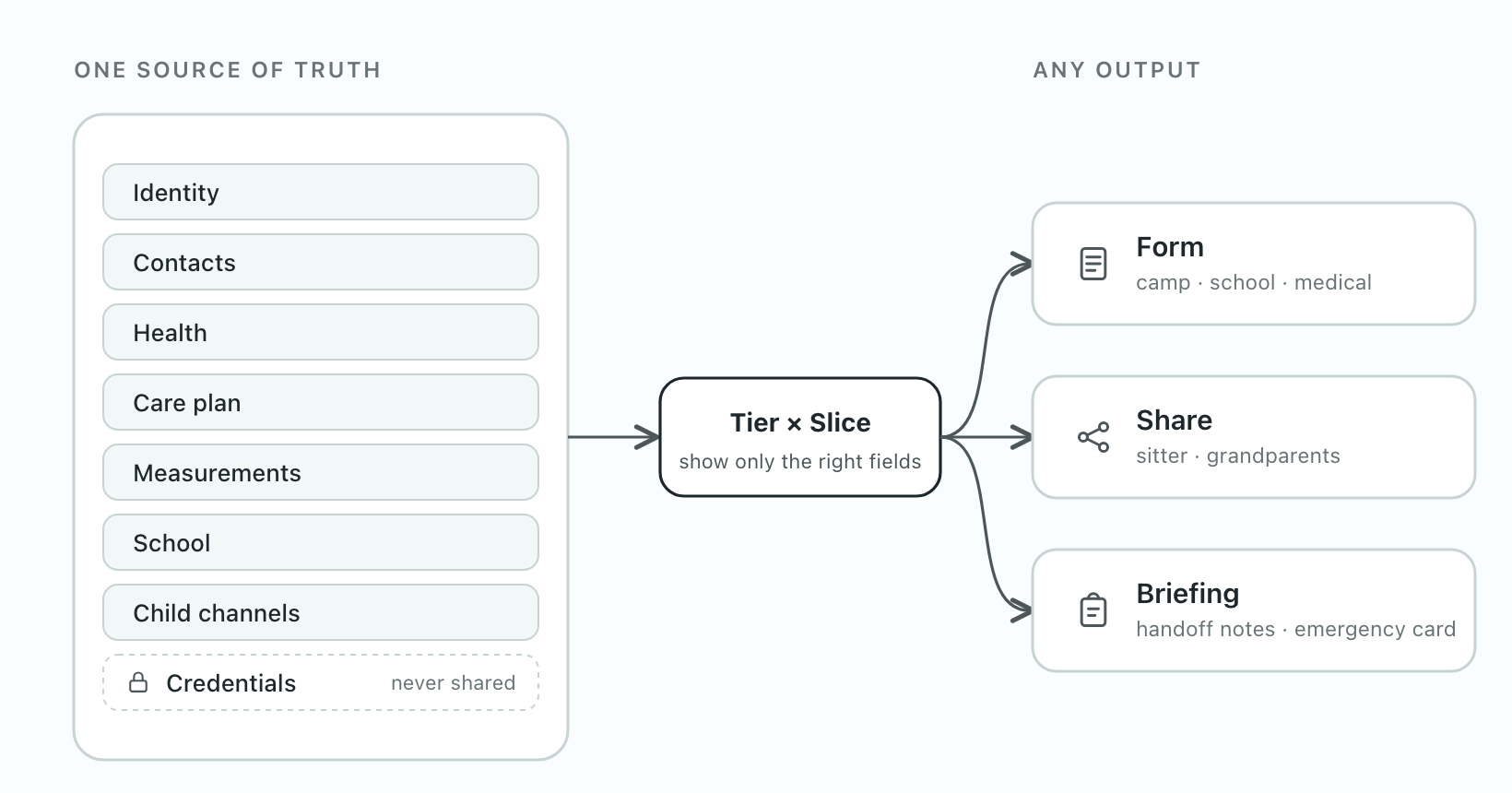
A babysitter note is a form. So is an emergency card. So is a share link: a form whose reader is one trusted person and whose fields are filtered to what they’re allowed to see.
Sharing isn’t a separate product. It’s an output.
Everything collapsed into one move: take the source of truth, render it into the shape someone’s asking for, show only the right fields. The six-tier system stopped being something the parent learns and became the filter logic underneath. The whole product fits on one line: enter it once, and Kiddex does the paperwork.
Checking my own story against the code
Before building anything new on top, I wrote an honest inventory: what actually exists, read from the code instead of my own pitch deck.
It was not flattering.
The deck promised SMS delivery. The code had never sent a single text. Every share was just a link.
The “constitutional” privacy guarantees were real in the code and had zero automated tests behind them. Nothing had ever met a stranger. It ran on one demo child.
Writing that down was the most useful hour of the project. The rebuild stands on a foundation I’ve inspected, not one I’ve been telling myself a story about.
What I learned…
Give people structure, then hide it.
The tier system was the right way to think and the wrong first screen. Elegance the user has to study isn’t elegance.
The simplest framing is usually the truest one.
“Family knower” sounded ambitious. “Output” sounded boring. Boring was right. I’ve stopped trusting the version of an idea that flatters me most.
Audit your own claims before you build on them.
A feature you can’t find in the code isn’t built. A guarantee with no test behind it is a hope. Writing down the unflattering truth early kept real work off a false story.
The overlap is the advantage.
I got tired of being my family’s integration layer, and I could build the fix, audit it honestly, and explain why it matters. Being the user, the builder, and the writer at once is the most useful thing about me.
What “done” looks like, and what it fixes
The output primitive is the whole bet, and most of it is still a promissory note. The finished thing, and the gap each piece closes:
Every output is an adapter. The form filler and the share are real; the briefing, the emergency card, and the conversational onboarding are drawings with no body. Done, they’re the same move on one engine: enter the thirty facts once, and whatever shape the world hands you renders from the single source of truth.
The wall gets tested, not sworn to. The credentials guarantee is enforced in three places and verified by zero automated tests. Done is a test suite whose only job is to try to smuggle a Social Security number out of every exit — and fail, every time.
It meets a stranger. Kiddex runs on one demo child and has never survived contact with a parent who isn’t me. Done is a small, honest beta with multi-kid families where at least one medical file is thick enough that the structured spine reads as mercy. Either the design holds or it gets humbled. Both are worth more than my conviction.
And the part “done” doesn’t have to fix, because the collapse already did: the parent never learns the tier system. The rings are plumbing now, invisible on purpose.